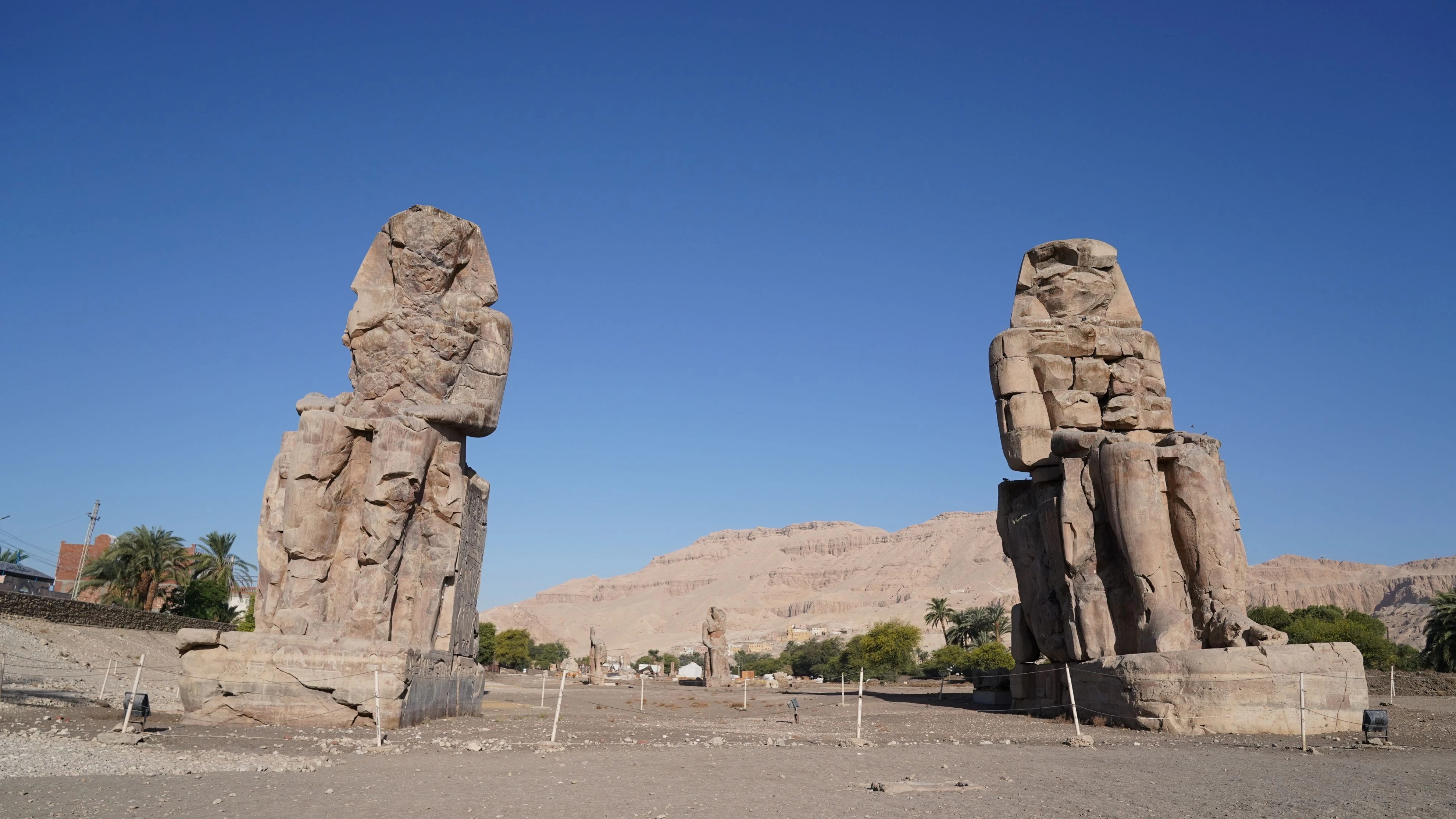
The Colossi of Memnon are two massive stone statues located on the west bank of the Nile near Luxor. They are among the most famous surviving monuments from ancient Egypt’s New Kingdom period.
These statues were built during the 18th Dynasty by Pharaoh Amenhotep III, one of Egypt’s greatest rulers. Amenhotep III reigned for more than 30 years and was married to Queen Tiye. He was also the father of Pharaoh Akhenaten.
The statues are the remaining fragments of Amenhotep III’s vast mortuary temple, which was once one of the largest temples in ancient Egypt. Much of the temple disappeared over time due to:
- Flooding from the Nile
- Earthquakes
- Erosion
- Reuse of stone blocks in later construction projects
Why Are They Called the Colossi of Memnon?
The name “Memnon” does not come from ancient Egypt. It was given later by the Greeks.
After a major earthquake damaged one of the statues in 27 BC, cracks formed in the stone. During the early morning, wind and temperature changes passing through these cracks created a mysterious sound.
Greek travelers associated this sound with Memnon, a legendary Ethiopian hero from the Trojan War who was said to have died at Troy. They believed the sound was Memnon “singing” or greeting his mother, the goddess Eos, at sunrise.
Because of this legend, the statues became known as the Colossi of Memnon.
Restoration by the Romans
In the 2nd century AD, Roman Emperor Septimius Severus ordered restoration work on the damaged statue. Once the cracks were repaired, the mysterious sound disappeared permanently.
Description of the Statues
- Height: Approximately 18–20 meters
- Material: Quartzite sandstone (often mistaken for limestone)
- Representation: Pharaoh Amenhotep III seated on the throne of Egypt
- Location: West Bank of Luxor near the Valley of the Kings
These statues remain one of the most iconic landmarks in the Theban necropolis and continue to welcome visitors entering the royal west bank of Luxor.
-webp.webp)
-webp.webp)