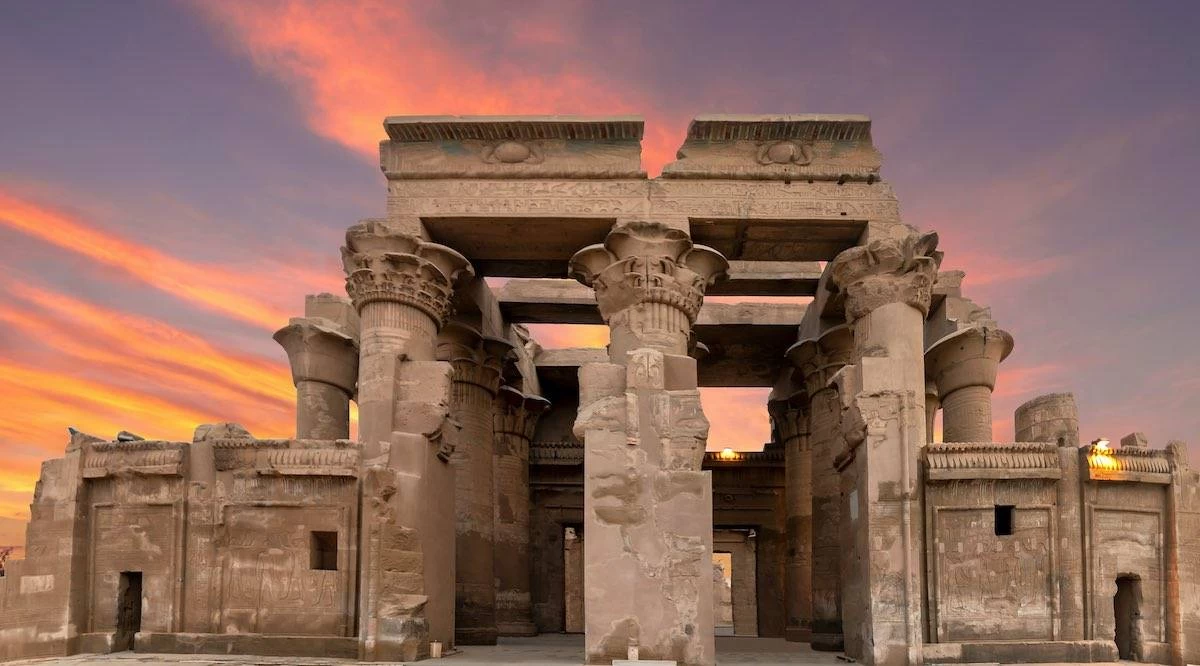
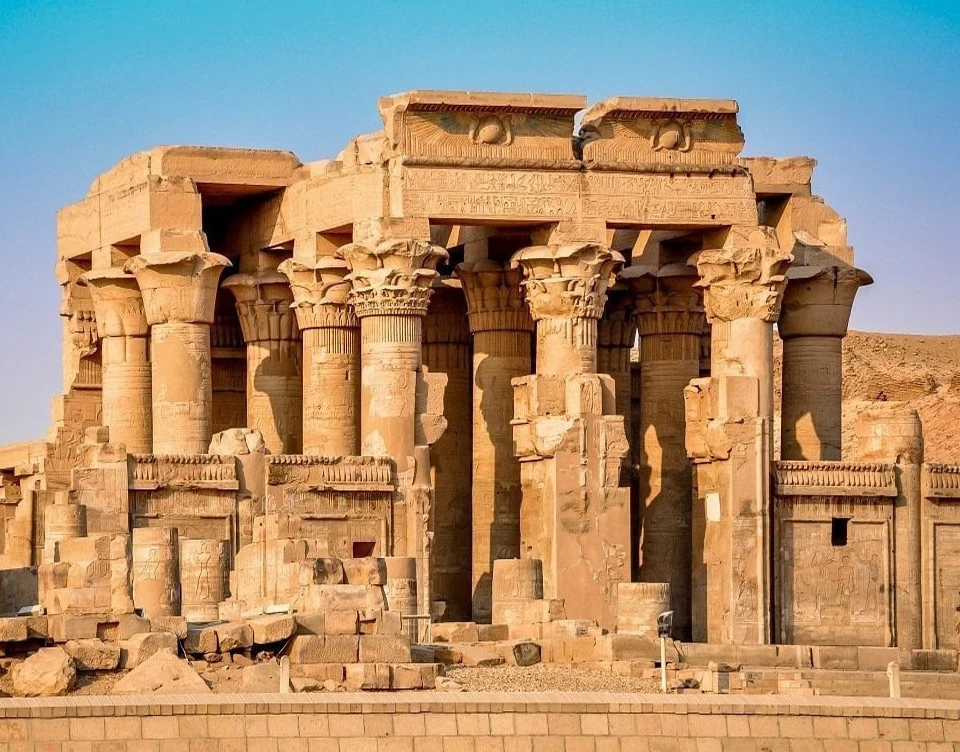
Kom Ombo Temple is one of the most distinctive temples built during the Ptolemaic period. It is uniquely dedicated to two gods simultaneously: Horus the Elder, and Sobek the crocodile god. The temple features two symmetrical and equivalent layouts, making it one of the rare “double temples” in Egypt.
History & Construction
Construction began under Ptolemy VI and continued through several Roman emperors.
Although the visible structure is Ptolemaic and Roman, the core of the temple dates back to ancient Egyptian times.
The temple took nearly 400 years to complete, much longer than similar temples of the era. This extended timeline may be due to seasonal construction during the low Nile season, or the temple’s proximity to major pilgrimage sites such as Edfu and Philae, which diverted resources and attention.
Kom Ombo was completely buried under soil and sand for centuries, which helped preserve its carvings, colors, and fine artistic details. Thanks to this preservation, it contains some of the most beautiful reliefs of the Ptolemaic world.
Mythology & Religious Significance
In ancient times, the site was known as Pa-Sobek, meaning “The Domain of Sobek.” Sobek, the crocodile god, had one of Egypt’s most ancient and powerful cults in this region, believed to protect fertility, water, and the Nile. The temple was also dedicated to Horus, the falcon-headed god of healing, protection, and divine leadership.
Unique Scenes & Highlights
Kom Ombo is famous for several extraordinary scenes:
1. Surgical Instruments Wall
In the rear section of the temple is one of ancient Egypt’s most remarkable reliefs — the catalog of surgical tools, including scalpels, forceps, scissors, hooks, suction devices, and birthing chairs.
This scene highlights the advanced medical knowledge of the pharaohs.
2. The Division of the Temple
A striking relief shows the goddess Maat (Justice) dividing the temple between Horus and Sobek, symbolizing cosmic balance and harmony between the two deities.
3. The Nile Meter (Nilometer)
The temple still contains the remains of a Nilometer, an ancient system used to measure the Nile flood levels. Priests used these measurements to help determine tax levels based on agricultural expectations.
4. Crocodile Mummies
Near the temple, archaeologists discovered a remarkable cemetery of mummified crocodiles, honoring the god Sobek. These are now beautifully displayed in the Crocodile Mummies Museum beside the temple.
-webp.webp)
-webp.webp)